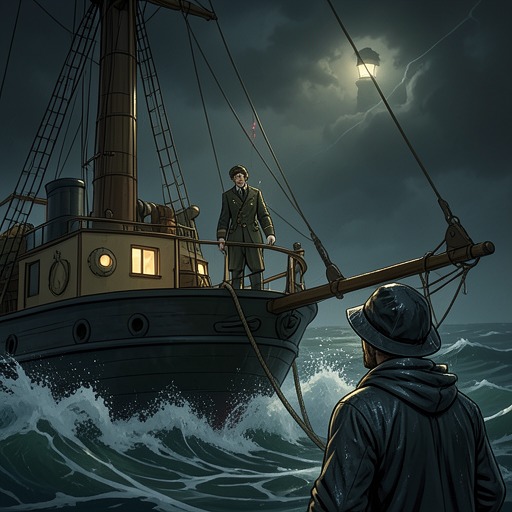
Caine withdraws from Saipan shore-battery fire without returning fire
The Caine Mutiny Court-MartialUSS Caine’s withdrawal from Saipan shore-battery fire without returning fire marks a sharp conflict between immediate combat action and Captain Queeg’s command. As the destroyer Stanfield came under attack, Willie Keith identified the battery and repeatedly asked to engage it. Queeg ordered Caine away and did not respond to Keith’s requests, leaving the ship’s guns silent while the destroyer fought on.
The crash and the attack
The episode began when a Navy Corsair flew over the island’s northern hills and suddenly burst into flame, falling into the sea between USS Caine and Stanfield. Keith, watching through binoculars, telephoned Captain Queeg. Queeg’s sleepy reply sent the minesweeper toward the crash at twenty knots; he reached the bridge in khaki shorts and bedroom slippers as the ships closed to about a thousand yards from the crash site. By then, no wreckage remained visible, only a rainbow-colored film of gasoline on the water.
Queeg’s brief farewell to the lost aircraft contrasted with Keith’s dawning recognition that a man had died. Keith felt ashamed of the disproportionate irritation Queeg had provoked in him and reconsidered his own self-pity: the death before him and the reports of many more dying ashore made shipboard grievances seem smaller. That inward correction did not last long. White columns of water rose on both sides of Stanfield, and Keith realized that the destroyer was being straddled by shore fire.
Keith identifies the battery
Queeg reacted to the splashes by ordering all engines ahead full and hard right rudder. Keith then saw an orange flash and black smoke high on a northern cliff, identified it as the battery, and called the gun watch. He gave its bearing as 045 relative and its distance as 4,000 yards, directing the crew to train the main battery on the position. The order was answered and the guns were brought to bear.
As USS Caine turned, its three-inch guns swung increasingly toward the stern. Stanfield, meanwhile, circled through the splashes and fired a salvo from its five-inch guns. Keith went into the pilothouse to report that Caine’s main battery was manned and on target. Queeg appeared not to hear him. Standing at an open window with a squinting smile, he neither turned his head nor acknowledged the report.
Withdrawal without a shot
Keith explicitly requested permission to bring USS Caine broadside and fire on the battery. When Queeg gave no answer, Keith made a narrower second request: permission to open fire with number four gun, which had a clear shot over the stern. Queeg still said nothing. The silence matters in the scene because the ship was not simply unable to respond: Keith had identified the position, the gun watch had been alerted, and he reported the battery within range with the guns manned and ready.
The officer of the deck ran out onto the wing and watched Stanfield recede while firing again. A thick ball of dust enveloped the cliff position, flames showing through it as the destroyer’s salvo struck. Stanfield was again straddled and fired four rapid salvos. The narrative leaves some uncertainty about the result: from the growing distance Keith could no longer tell whether more shells were landing near the destroyer. What it makes clear is that USS Caine continued away and did not fire. The movement toward the crash had become a withdrawal from the scene of an ongoing attack.
The log and the campaign’s end
Keith whispered an account of the incident to Steve Maryk after dinner. Maryk made no comment, but later that night recorded it in his log as information reported by an officer of the deck, explicitly noting that he had not witnessed the episode firsthand. His entry described Stanfield under fire about a thousand yards off Caine’s beam and stated that Captain Queeg reversed course and left without firing, although the battery was within range and Caine’s guns were manned and ready. The log thus preserves both the substance of the accusation and its source: Maryk’s account is a written report of Keith’s observation, not Maryk’s own eyewitness testimony.
The episode stands out against the minesweeper’s wider role in the campaign. Before the Saipan campaign was over, USS Caine was detached from the attack force and ordered to escort a damaged battleship to Majuro; its part in the Marianas battle ended there. The contrast is pointed: during the shore attack, Caine possessed a target and ready guns but left without firing, and soon afterward it returned to the supporting routine of escort duty. The event therefore makes the gap between a crew’s capacity to act and its commander’s decision not to act a concrete matter of record.